
Selling
Taxes when selling a house in Spain in 2026: the complete guide
Municipal capital gains tax (plusvalía), income tax on the gain, reinvestment exemptions and the 3 % withholding for non residents. Figures verified as of August 2026.
31 August 2026 · 7 min · Azur Invest · updated 15/09/2026
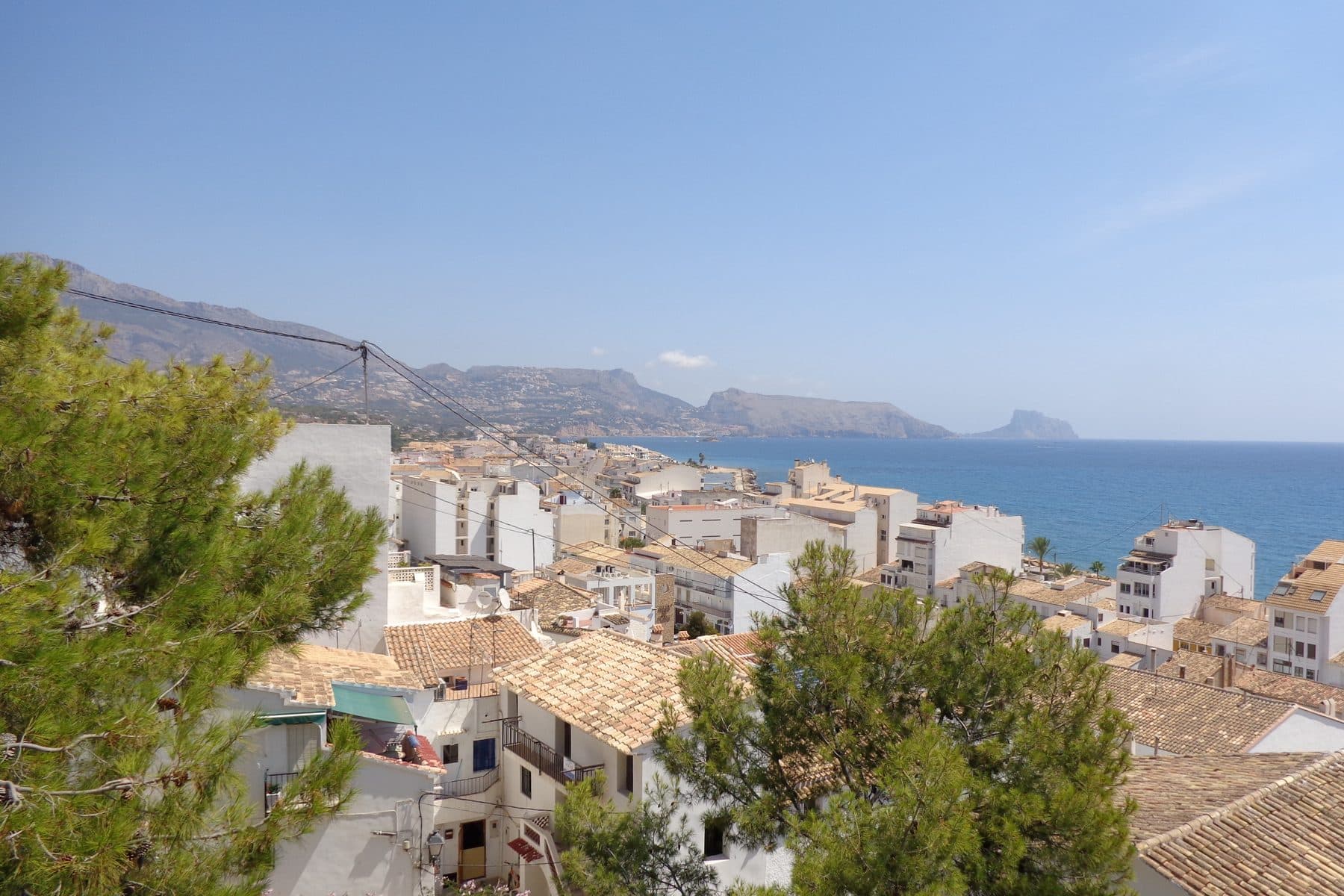
Photo: Superchilum · CC BY-SA 4.0
Selling a house in Spain can trigger municipal tax and tax on the gain: the municipal capital gains tax (plusvalía municipal), income tax on the gain if you are tax resident, or non-resident income tax if you are not, with 3 % withheld on account. Here is each one with figures verified as of August 2026.
We work with Spanish, Belgian, Dutch, French and Nordic clients, so this guide covers both the case of the Spanish tax resident and that of the non resident, which in Altea is a very common situation.
Plusvalía municipal: the two calculation methods
The plusvalía municipal, technically the Tax on the Increase in Value of Urban Land (IIVTNU), is paid by the seller to the town hall for the increase in the value of the land between purchase and sale. Since the reform of Royal Decree Law 26/2021, later incorporated permanently into the consolidated Local Finance Act, there are two methods and you can choose the one that is more favourable to you:
- Objective method. Multiplies the cadastral value of the land by a coefficient that depends on how many years you have owned the property. Use the coefficient in the municipal ordinance in force on the transfer date, within the applicable statutory maximum.
- Real method. Starts from the actual gain on the transaction, that is, sale price minus purchase price, and applies to it the percentage the land represents of the total cadastral value.
If the real method works out cheaper than the objective one, you have to request it expressly and prove it with the purchase and sale deeds; the town hall does not apply it automatically. And if there has been no real increase in value, for example if you sell for less than you paid, you are entitled to pay nothing by declaring non liability to the town hall itself.
Income tax: the capital gain and its 2026 brackets
If you are tax resident in Spain, the difference between the sale price and the purchase price, after deducting the costs and taxes associated with both transactions, is taxed in your income tax return (IRPF) as a capital gain within the savings base. In 2026 the brackets are:
| Gain bracket | Applicable rate |
|---|---|
| Up to 6,000 € | 19 % |
| From 6,000 € to 50,000 € | 21 % |
| From 50,000 € to 200,000 € | 23 % |
| From 200,000 € to 300,000 € | 27 % |
| From 300,000 € | 30 % |
The rate is applied progressively by bracket, as with the rest of the savings base, not as a single rate on the whole gain.
Exemption for reinvestment in a main residence
If the home you sell is your main residence and you reinvest the proceeds in the purchase of another main residence, you can be exempt from tax on the gain. The period is two years, counted from the sale forwards or backwards, so you can buy before or after selling. The exemption is proportional: if you reinvest 100 % of the amount, the gain is fully exempt; if you reinvest less, only the proportional part.
Exemption for those aged 65 or over
If you are 65 or older on the date of sale and you sell your main residence, the gain is exempt with no need to reinvest in anything. If what you sell is another property, such as a second home, you can also be exempt by reinvesting the amount in an insured life annuity, under these conditions: take it out within six months of the sale, a maximum reinvestment limit of 240,000 €, and the annuity must start paying within twelve months.

The 3 % withholding when the seller is not resident
If you sell a home in Spain without being tax resident here, general income tax does not apply. Instead, the buyer is obliged to withhold 3 % of the agreed price and pay it to the tax office using form 211, within one month of the sale. This withholding is not an additional tax; it is a payment on account of the tax due by you as seller.
Afterwards, you as the non resident seller file form 210 declaring the real gain, that is, sale price minus purchase price with its associated costs, within three months after the one-month period following the transfer has elapsed. The capital gain is taxed at 19 %, regardless of the country of residence; this should not be confused with the rates for other non-resident income.
The 3 % already withheld by the buyer is deducted from the result. If the withholding was higher than your real tax, the tax office refunds the difference. If it was lower, you pay the difference. And if you sell at a loss, you are entitled to a refund of the full 3 %.
Summary table by situation
| Seller's situation | Main tax | Rate or bracket |
|---|---|---|
| Tax resident, main residence, reinvests in another main residence | Income tax, fully or partly exempt | 0 % of the reinvested amount |
| Tax resident, aged 65 or over, main residence | Income tax, exempt | 0 % |
| Tax resident, no exemption applicable | Income tax on capital gain | 19 % to 30 % by bracket |
| Non resident, EU, EEA, Norway or Iceland | Non resident income tax via form 210, with 3 % withholding on account | 19 % |
| Non resident, other countries | Non resident income tax via form 210, with 3 % withholding on account | 19 % |
Municipal capital gains tax can apply to transfers of urban land where value has increased, subject to exemptions. When the seller is a non-resident individual, the buyer acts as substitute taxpayer.
Costs you can deduct from the gain
The capital gain is not calculated simply as sale price minus purchase price. You can add to the acquisition price the costs and taxes you paid when buying, such as notary, registry, gestoría fees and transfer tax or VAT, and also the cost of structural improvements made afterwards, not simple maintenance repairs. From the sale price you can subtract the costs directly associated with the transaction, such as the agency commission or the cost of the plusvalía municipal itself.
The better documented these costs are with invoices, the lower the declared gain and the lower the tax. Keep the purchase invoices and those of relevant renovations from day one, not only when you decide to sell.
A worked example
A tax resident who bought a home in Altea for 300,000 € eight years ago and sells it now for 420,000 €, with 12,000 € of documented purchase and sale costs, declares a gain of 108,000 €. With the 2026 brackets, they would pay 19 % on the first 6,000 €, 21 % on the next 44,000 € up to 50,000 €, and 23 % on the remaining 58,000 € up to 108,000 €. The approximate result is 23,720 € of income tax, to which the plusvalía municipal, calculated separately, must be added. This is an illustrative example, not a valid calculation for your specific case.
This is general guidance, not tax advice: every transaction has nuances of acquisition dates, deductible costs and personal circumstances that change the result. Confirm your specific case with a lawyer or tax adviser before signing.
Before calculating taxes, confirm the sale price
The tax is calculated on the real sale price, so the first step is a valuation in line with the market. Request your free valuation and, if you want to see the full process from valuation to notary, read selling a house in Altea step by step. To discuss your specific case, contact us.
Source: Spanish Tax Agency: capital gains from property transfers by non-residents.
From our portfolio
A property for sale in Altea right now
See the whole Altea portfolio
Frequently asked questions
- What taxes does the seller of a home in Spain pay?
- The municipal capital gains tax (plusvalía municipal, IIVTNU) and, if there is a gain, income tax on that capital gain if you are tax resident in Spain. If you are not resident, non-resident income tax applies to the gain, with 3 % of the price withheld and paid in by the buyer on account.
- How is the plusvalía municipal calculated in 2026?
- With two methods: the objective one, which multiplies the cadastral value of the land by a coefficient based on the years of ownership, and the real one, which applies the land percentage to the actual gain on the sale. Since the 2021 reform you can choose whichever is cheaper for you.
- Am I exempt from income tax if I am over 65?
- If you sell your main residence and you are 65 or older, yes, with no need to reinvest. If you sell another type of property, you can be exempt by reinvesting the amount in an insured life annuity within six months, up to a limit of 240,000 €.
- What is the 3 % withholding for non residents?
- It is the amount the buyer withholds from the price and pays to the tax office using form 211 when the seller is not tax resident in Spain. The seller recovers it in full or in part by filing form 210, depending on their real gain.